
Announcement: giving.sg is undergoing scheduled maintenance downtime until 28 Feb 2026. For enquiries, please contact [email protected].
Announcement: Lorem ipsum dolor sit amet consectetur. At leo non in lobortis faucibus aenean aliquam morbi. In neque orci aliquam consequat massa. Vitae aliquam scelerisque erat faucibus. Volutpat sem mattis velit sagittis vel

Exiting is known by multiple names—resigning, offboarding, leaving the community. They all describe the necessary and eventual end to one’s time in an organisation or community.
Beyond the individual, the exit phase of one’s community journey affects a variety of stakeholders; they include the peers that remain, the leaders managing the exit, as well as the overall community responding to the individual’s departure. As community leaders, it is thus essential to shape a positive exit experience for all who are involved.
NVPC’s Community Matters team recently held a webinar on 8 December 2021 as part of its Community Leadership Series. This article highlights the useful lessons shared by the panel of guest speakers and discussions during the breakout sessions. You’ll be able to glean tangible strategies to facilitate a positive exit phase, and tips to broach difficult exit conversations.
You can watch a recording of the webinar, entitled Saying Goodbye: How to Shape a Good Exit Experience, here.
For community leaders, an individual leaving presents a useful learning opportunity to understand the person’s experience and the reasons behind their decision to leave. Identifying push factors for their exit can help to minimise future attrition and improve the management of the community for others still in it.
Exits may also happen due to external pull factors. In such cases, Shaily Gupta, Chief Advisor of Human Resources Consulting at Engee Advisors, shares, “The pull factors are beyond our control. People will get opportunities in this world, and we need to celebrate that for them.” Celebrating their new opportunities also creates closure for the individual leaving, and allows them to end their community journey on a positive note.
Ambassadorship is a valuable outcome from someone who leaves your community; a wider network can be reached with former members continually representing the community in a positive light. Ensuring a good departure experience is all the more favourable and worth investing in.
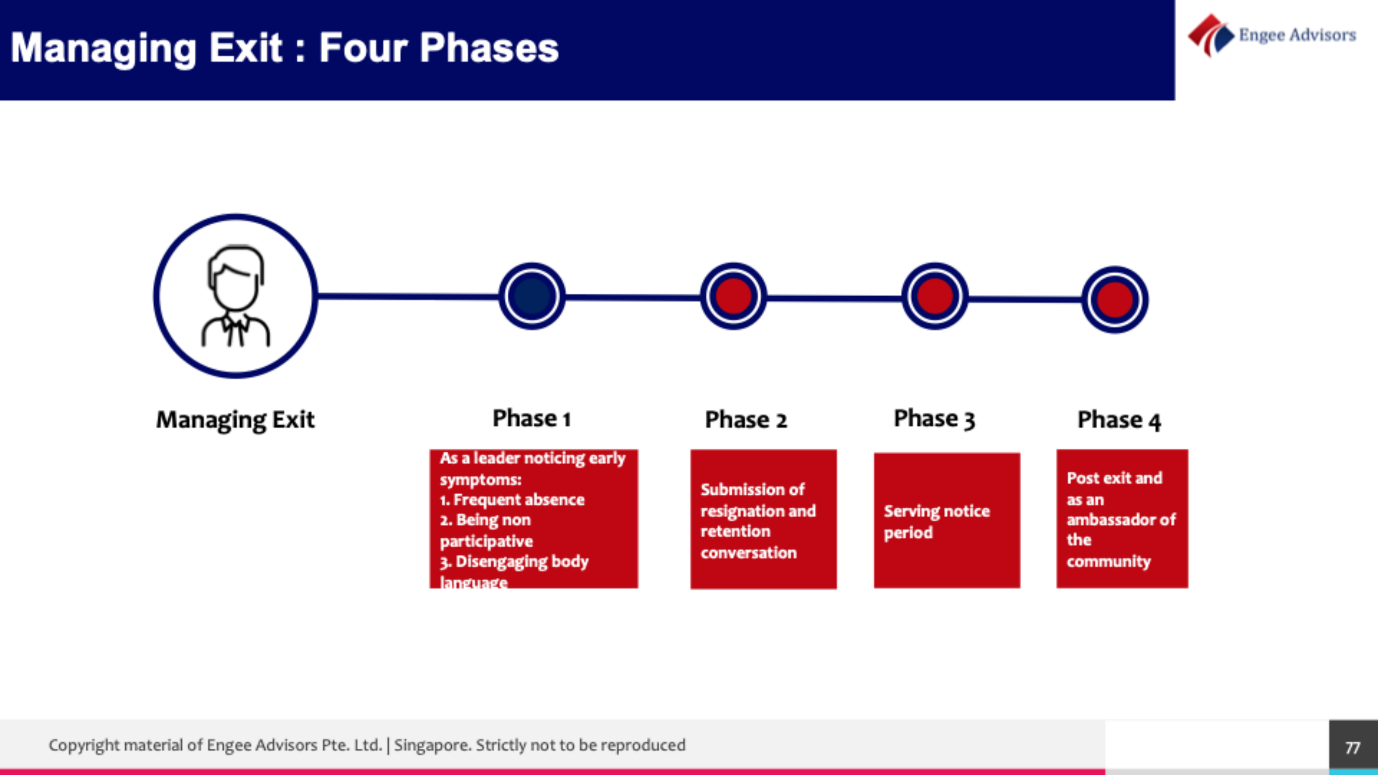
It is important to acknowledge that an individual’s exit experience begins before the actual leaving happens. To help community leaders invest in their entire exit process, Shaily breaks down the exit experience into four phases:
During this period, an individual may be contemplating leaving the community. The individual may be frequently absent, non-participative, and increasingly disengaged from the community. Shaily advises community leaders to be proactive in engaging community members to check in on their experience in the community, and be aware of these signals before the individual puts forth their official resignation. This is the best phase to re-engage, especially if you wish to retain them in the community.
When this conversation takes place, as a leader, it is important to ensure that the conversation is as restorative as possible. This entails highlighting the value that the leaving individual has brought to the community, and having an open discussion about their reasons for leaving. Providing opportunity for this conversation, whether or not the individual chooses to partake in it, allows the space for the individual to ventilate and possibly address some hurtful feelings or situations rather than carry that to the next workplace.
At this juncture, members of the community will become aware of their peer’s nearing exit. Community leaders should do their best to manage the change within the community to ensure that the operational and talent loss will not be felt by those who remain. Ensure that any handover to remaining members is conducted. You may want to widen the circle and involve other colleagues, especially those who have a good relationship with the individual leaving, to take ownership of planning and implementing the farewell experience.
While the individual’s exit marks the end of their position as a member of the community, it also represents the start of a new relationship that can be equally meaningful. They may become an advocate or ambassador in support of the community despite formally leaving it. Community leaders should be mindful to consider the post-exit phase when shaping exit experiences by being intentional about retaining informal yet fruitful relationships with exiting individuals.
While these four phases can be more defined for organisations with concrete systems and protocols, a similar but shortened process is present for volunteer communities. Alvin Chew, the Ex-Chief Curator of Young ChangeMakers (YCM) contextualises the exit experience for volunteers, emphasising the leap from Phases 1 to 4 for more casual communities.
For volunteer communities, different people will have varying expectations and ways to end their terms of service—there is no one-size-fits-all approach that can be distilled into a singular exit protocol practice. One helpful way is to ask the individual to describe how he/she would like to meaningfully exit the community. This empowers the individual and communicates that the individual’s voice matters, from start to end.
Justin Mui, Executive Director of Lutheran Community Care Services (LCCS) shares three principles he abides by when shaping exit experiences. These three principles are among seven working principles that shape LCCS’ practice.
It all boils down to bringing value to the individual who is leaving. In tangible terms, concrete support may include offering recommendation letters to aid the individual’s forthcoming pursuits, a custom that Alvin and the YCM team practises.
A positive exit experience can also be made simply by listening to feedback and taking what is shared seriously to implement meaningful changes for the community. Adding a human touch with a personal “thank you” message validates the leaving individual as well. To round off the exit, community leaders can consider leaving the door open for the leaving individual to re-join the community in the future.
Justin shares his organisation’s practice of “Goodbye Circles”—a conversation hosted for the leaving individual at the end of their journey with LCCS. A Goodbye Circle offers the opportunity for closure for both the individual and the community that remains, regardless of the extent and duration of the leaving individual’s service, as well as the circumstance of their goodbye.
The reflections shared are facilitated around 3 ‘A’s:
But the reality is that not all exit experiences are smooth-sailing and easy to navigate; some of the mentioned strategies may work better in theory than in real life. Shaily gives some tips to manage tricky involuntary exits, from the perspective of three stakeholders:
During the session, the participants split into smaller breakout rooms to share their experiences with exit phases in their own communities. Here are some of the practices they shared:
The exit phase is a natural and necessary part to everyone’s journey in a community. Following through well, and till the very end concludes the leaving individual’s experience with a positive and lasting impression of your community.
For a structured guide to help you shape a good exit experience, download the Community Journey Journal for Developers here.
If you would like to get connected with LCCS for further clarification on their practices, you can reach them here.