
Announcement: giving.sg is undergoing scheduled maintenance downtime until 28 Feb 2026. For enquiries, please contact [email protected].
Announcement: Lorem ipsum dolor sit amet consectetur. At leo non in lobortis faucibus aenean aliquam morbi. In neque orci aliquam consequat massa. Vitae aliquam scelerisque erat faucibus. Volutpat sem mattis velit sagittis vel
A Handbook on Effective Non-Profit Boards highlights eight factors as well as the insights and recommendations to build an effective non-profit board based on evidence from the Board Leadership Study 2019/2020.
The Centre for Non-Profit Leadership (CNPL), part of the National Volunteer & Philanthropy Centre (NVPC), is proud to launch the findings of the Board Leadership Study 2019/2020 (BLS) in partnership with Deloitte.
Two years in the making, the Board Leadership Study 2019/2020 presents findings from a nationally representative sample of Board Chairs, Executive Directors, and Chief Executive Officers from 360 non-profit organisations (NPOs) across various sectors. It is supplemented by in-depth qualitative interviews with some of these leaders.
These insights as well as other data from the Board Leadership Study formed the framework and recommendations found in A Handbook on Effective Non-Profit Boards – elaborated on below – that can be used by NPO leaders to improve their board effectiveness.
1. Value-based leadership is key
Having leaders with the right values and motivations directly impacts the effectiveness of NPO boards. Across various factors measured in the study, NPO boards performed best on ‘Aligned Values and Motivations’, with 91 per cent of NPO leaders agreeing to this assessment of their board. Being aligned in values and motivations encompasses traits such as acting in the charities’ best interests, being passionate for the cause, and more.
2. Stronger governance deepens trust
The Board Leadership Study found governance and compliance among NPOs to be increasingly stronger over the past four years, with a four-fold increase in the formalisation of board renewal plans between 2016 and 2020. With more NPOs disclosing board-related information on their annual reports, this progressive trend towards stronger governance and accountability would help to inspire public trust in the non-profit sector.
3. NPOs can improve on self-evaluation
22 per cent of NPOs identify self-evaluation as the most important attribute relating to governance and compliance. However, there is a gap between perceived importance and performance. The surveyed NPO leaders rate their conduct of self-evaluation to be one of the lowest among all other attributes contributing to board effectiveness – 70 per cent compared to the average of 81 per cent. This signals a pressing need for an accessible tool for NPOs to take stock of their own board health.
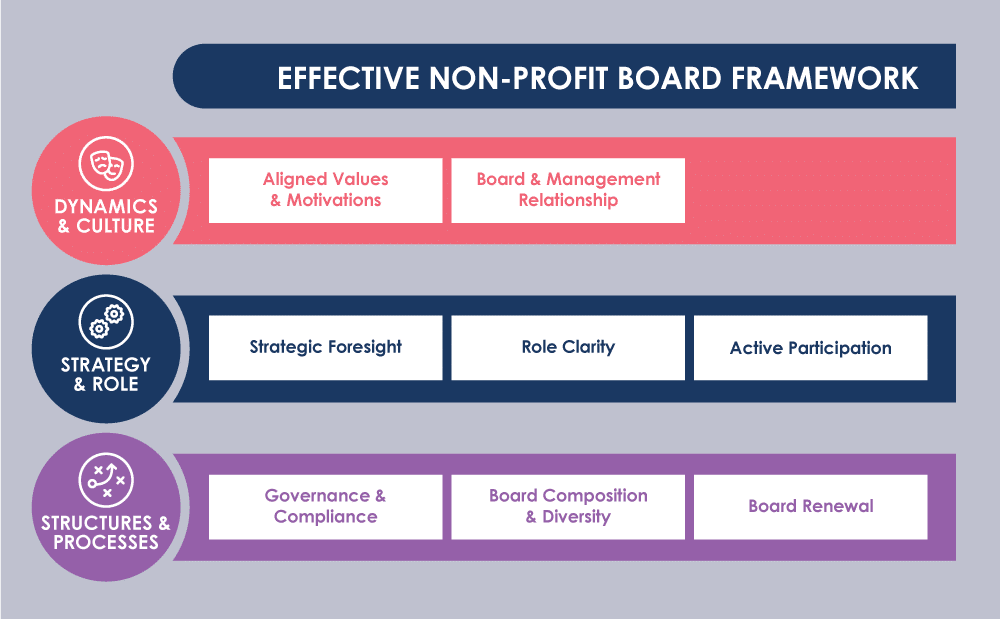
At the heart of the study is the question: what makes an effective board?
CNPL is proud to introduce the Effective Non-Profit Board Framework, the first comprehensively researched framework in Singapore backed by a national study of NPO boards across sectors. It identifies 3 levels and 8 factors that influence Non-Profit Board Effectiveness.
The framework was done in discussion with the Charities Unit, non-profit leaders, the Tote Board, and the National Council of Social Service. We are also grateful to have journeyed with other sector partners such as the National Arts Council, Sports Singapore, Ministry of Social and Family Development, Ministry of Health, People’s Association, Ministry of Education, as well as the Singapore Institute of Directors and Council for Board Diversity, who provided critical input to the findings.
To bring this framework to life, we have put together A Handbook on Effective Non-Profit Boards that extensively fleshes out the framework in detail. Each factor comes with dedicated sections that deep dive into concrete developmental plans, how the factor is practised in reality, as well as tips and resources for boards who want to get started right away. There is even a helpful checklist for each factor to help you identify current gaps in your board practices.
For more information, click the button below for your free copy of the handbook.